Your readings
The Subak system in sustainable water management
Introduction
Did you know that rice paddies can do more than just grow rice?
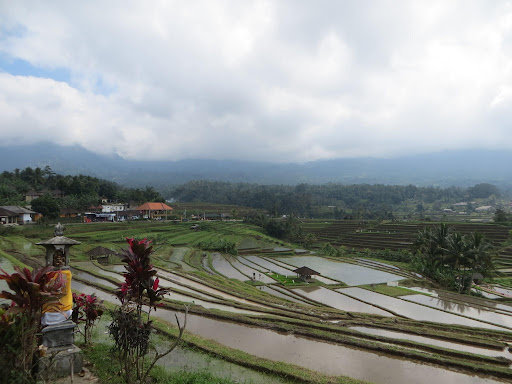
Rice paddies, often seen as ordinary farmland, play an important role in maintaining environmental balance. One interesting example is the Subak system used by farmers in Bali. It not only manages water in the fields but also draws on local wisdom—knowledge and practices passed down through generations to sustain farming and the environment.
This local wisdom includes an understanding of a harmonious relationship between people and nature, and ecological principles aligned with local social and cultural conditions, helping ensure natural resources for future generations. For example, the bamboo shrine (sanggah) for offerings to Dewi Sri (the deity as protector and sustainer of rice and the fields) in Figure 1 reflects Subak-specific local wisdom and Balinese Hindu culture, which emphasizes harmony among God, humans, and the environment.
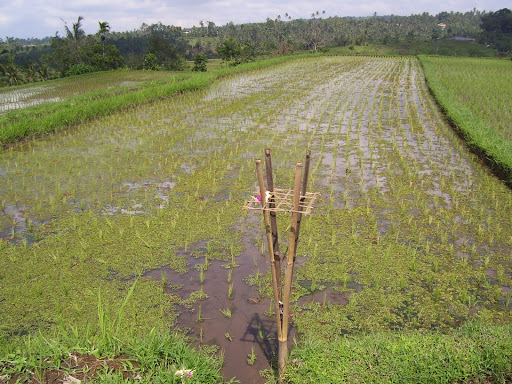
Figure 1. A bamboo shrine as an expression of local Subak farmers’ wisdom
In this unit you will learn how to manage water efficiently in the Subak system to support sustainable farming, reduce greenhouse gas emissions, and increase rice yields. You will also use an interactive simulation to explore water management, soil temperature, and methane emissions.
Why does this matter?
We often hear about climate change and how it affects our world. A major driver is greenhouse gas emissions from human activity, including agriculture. In many developing countries, agriculture depends heavily on water for food production, especially rice. Yet inefficient water management can increase methane emissions that harm the atmosphere.
Did you know that the Subak system has helped cut greenhouse gas emissions in Bali by up to 70%? Using intermittent irrigation or macak-macak (alternating wet and dry periods), farmers save water and reduce methane emissions that contribute to global warming. Please read the following article on a Bali field experiment on water management in rice paddies. It shows how small changes in farming can have large effects on the environment and yields. Read this article and consider how similar ideas might apply where you live.
What will you learn?
- Efficient water management: Simulate how to regulate and manage paddy water in a more efficient, environmentally sound way.
- Climate impacts: Analyze how poor water management can increase methane emissions, and how intermittent irrigation can reduce them.
- CSDT simulations: Use technology to monitor soil temperature, water volume, and methane in the paddy in near real time.
- Collaboration in groups: Work in teams to prepare a scientific report and poster explaining experiment results from the simulation.
Integrating traditional and modern knowledge in the Subak system
The Subak system does more than move water from upstream to downstream; it is a social system that involves the whole village. Farmers in Bali cooperate to balance water across their fields, creating a sustainable water-management model. It is a concrete example of how traditional knowledge and modern technology can address farming and environmental challenges together.
Through simulations based on CSDTs (Culturally Situated Design Tools)—learning technology that connects science concepts with local cultural context—you can integrate traditional and modern knowledge in the Subak system and broader Balinese culture via this link: https://csdt.org/culture/bali/en/index.html. CSDTs are designed to connect scientific theory with everyday life and to help you address local challenges using science and technology. With this learning technology, you learn science while seeing how technology can support positive change in communities. CSDTs offer integrated learning that links science and culture and gives you tools to meet real-world challenges.
For example, Bali’s bamboo-weaving tradition—producing crafts across Bali and Indonesia—shows how local culture and modern science connect. Weaving patterns can be described mathematically as a Cartesian coordinate system: coordinates formed by a horizontal axis (X) and vertical axis (Y) on grid paper. The patterns link geometry, science (biology, bamboo), and everyday mathematics. With CSDTs, you can try virtual bamboo weaving and see how math appears in cultural practice, via this link: https://csdt.org/projects/51235/run?lang=en#.
What will you do in this unit?
1. Experiments and simulation
You will run experiments to see how soil temperature and water management affect methane emissions and rice yield using the CSDT-based interactive simulation at: https://csdt.org/projects/51384/run, as shown in the screenshot (Figure 2).
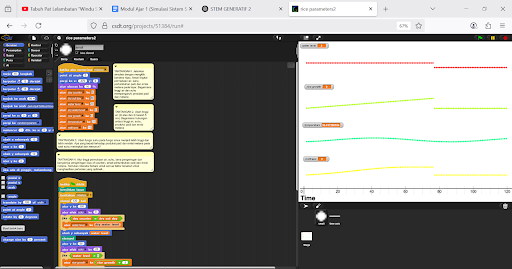
Figure 2. Screenshot of the CSDT simulation linking water level, temperature, methane emissions, and rice production
The simulation lets you work directly with experimental data and explore relationships among soil temperature, water volume, methane, and rice yield in a more realistic setting. Through these experiments you will see why combining local knowledge with modern technology matters for efficient, environmentally friendly farming. CSDTs teach science while showing that technology can be a positive force for change and skills that matter for sustainability challenges facing communities.
2. Expert group discussion
You will work in small groups to study temperature, water volume, or methane in depth. You will then return to your home group to share findings and prepare a scientific poster on water management in the Subak system.
3. Scientific poster
Each group will produce a scientific poster describing the experiment. Posters should include data analysis, findings, and recommendations relevant to sustainable agriculture.
Why engage with this material?
- Protecting the environment: You will learn how efficient, environmentally sound water management helps maintain ecosystem balance and mitigate climate change.
- Building collaboration skills: You will work in groups and practice sharing ideas and solutions with peers.
- Technology for sustainability: With the tools provided, you can monitor experimental data in near real time and make evidence-based decisions.
Challenges you will explore
- How do changes in water level and temperature affect rice production and methane emissions?
- What is the impact of using technology to manage water efficiently?
- How can the Subak system reduce agriculture’s negative impacts on the environment?
Learning objectives
After completing this unit, you should be able to:
- Explain how intermittent irrigation (macak-macak) works in the Subak system and how it affects water management.
- Analyze experimental data on soil temperature, water volume, and methane in the context of sustainable agriculture.
- Prepare a scientific poster from your experiment and present recommendations for more efficient, environmentally sound water management.
Closing
Through this module you will not only study theory but also gain hands-on experience using technology simulations to address real farming problems such as water management and environmental impacts. By combining local knowledge with modern technology, you can help create sustainable solutions for more environmentally friendly agriculture.