Session 1 (3 periods)
A. Preparation
- Subak images
- Subak video
- Student attendance
- Teaching module
- Student worksheets
- Pre- and post-tests
- Formative and summative assessment sheets
- Media and writing supplies
B. Opening (20 minutes)
- The teacher opens with a greeting and prayer.
- The teacher checks attendance.
- The teacher outlines why the upcoming lesson matters.
- The teacher connects the lesson to daily life, especially farming with intermittent irrigation (macak-macak) and its effects on methane emissions and yields.
- The teacher introduces the topic, the problem to be solved, and the learning objectives.
- The teacher briefly explains cooperative learning: students work together on projects or tasks using project-based learning (students collaborate to produce a project that addresses a real problem and a product to present) and the Jigsaw method (students work in small groups to study part of the material, then share what they learned with members of other groups).
- The teacher explains how assessment will work.
- The teacher administers the pre-test, explaining that it measures understanding of the upcoming material, not overall ability. The pre-test helps the teacher see what students already know and what needs more attention during the unit.
C. Main activities (60 minutes)
1. Learning stimulus (10 minutes)
Have you heard that rice paddies can contribute to greenhouse gases? Did you know that more than 200 million paddies in Asia produce about 11% of global methane emissions? Recently, farmers in Bali cut greenhouse gas emissions by up to 70% and increased rice yields in a more environmentally friendly way. They did it by changing how water is managed in the fields, using intermittent or macak-macak irrigation, which not only saves water but also reduces pesticide runoff. Balinese farmers generally understand how much water rice needs for optimal growth, as in Figure 2. When rice is only 3–4 days after transplanting, the flood depth is relatively low so roots can gradually adjust to the new environment.
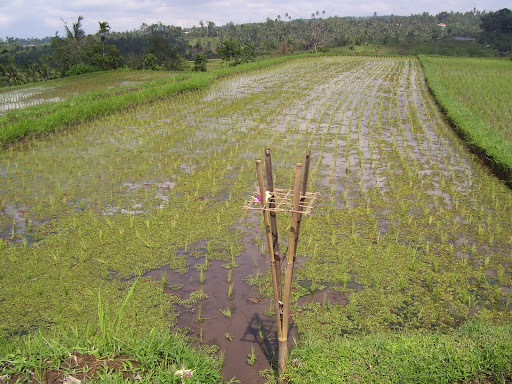
Figure 2. Relatively shallow floodwater on rice seedlings at 3–7 days after transplanting.
Please read the following article on a Bali experiment on water management in rice paddies. It illustrates how small changes in farming can have large effects on the environment and yields. Read this article and consider how similar ideas might apply where you live.
What can we learn from this experiment to support more environmentally friendly farming?
(Source: https://news.mongabay.com/2023/08/bali-rice-experiment-cuts-greenhouse-gas-emissions-and-increases-yields/, accessed Monday, June 30, 2025, 08:16 WITA)
2. Assigning and explaining expert and home groups (10 minutes)
The teacher explains that in the cooperative Jigsaw model, students form two kinds of groups: expert groups and home groups.
- Expert group: Each expert group studies one topic in depth. The group works together to understand specific concepts or material and produce a product (such as a report, concept map, or graph). The expert group’s job is to master the topic, then return to the home group to share what they learned with home-group peers.
- Home group: A home group brings together students with different expert topics. They combine information each expert learned. The home group discusses what experts share, draws conclusions, and completes a larger task or project by integrating knowledge from all topics.
- Codes for expert and home groups: This unit uses numbers (1, 2, 3, 4, and 5) for expert groups and letters (A, B, C, D, E) for home groups. Each student gets a unique code—for example, A3 means home group A and expert group 3—as shown in Figure 3.
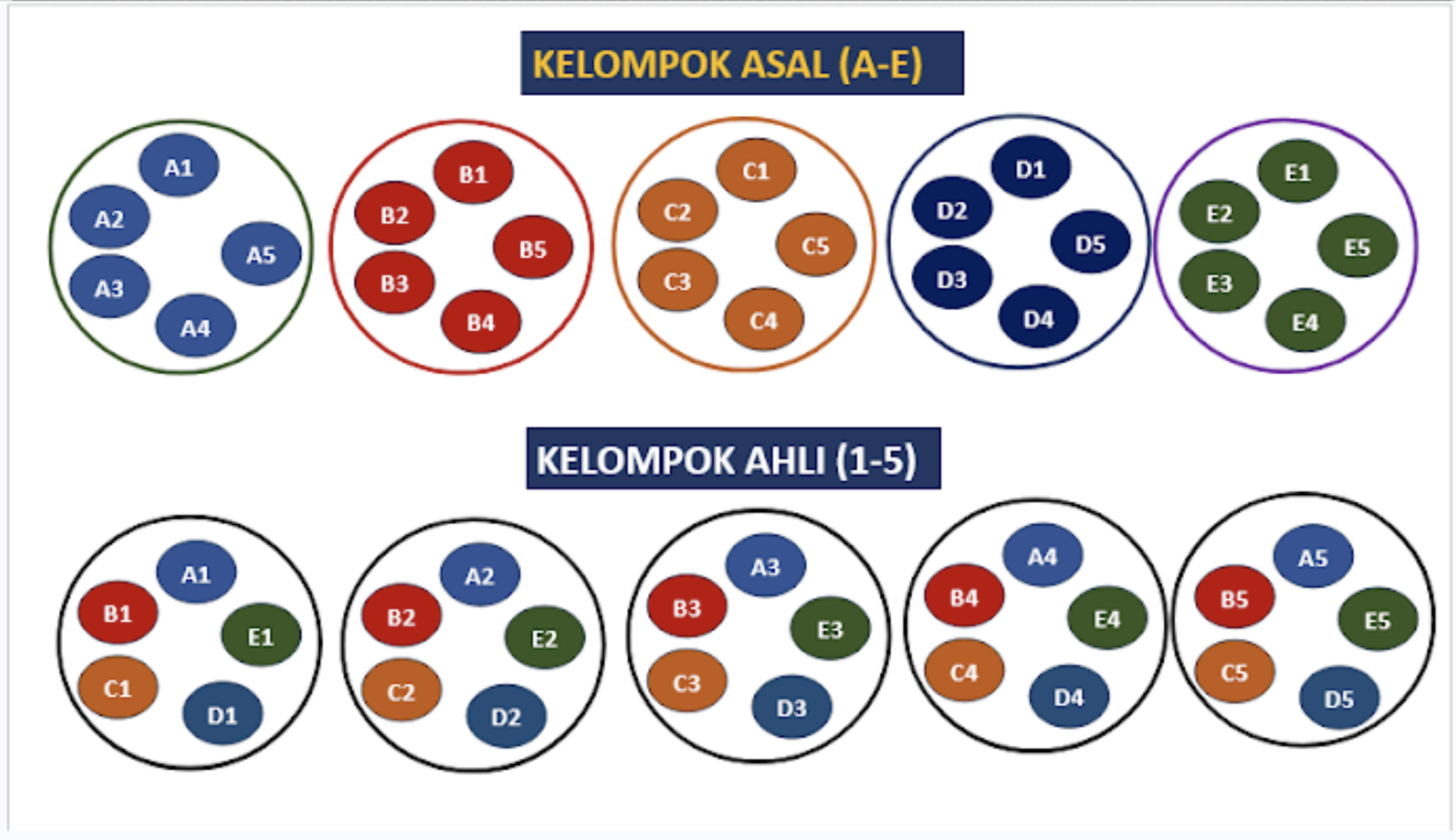
Figure 3. Home groups and expert groups
3. Expert group work and discussion (50 minutes)
- Expert groups work in parallel. Each expert group works independently and at the same time on its topic so students can finish without waiting for other groups.
- Discussion in the expert group. Students use the CSDT simulation at https://csdt.org/projects/51384/run to collect data and analyze information relevant to their topic (Figure 4).
-
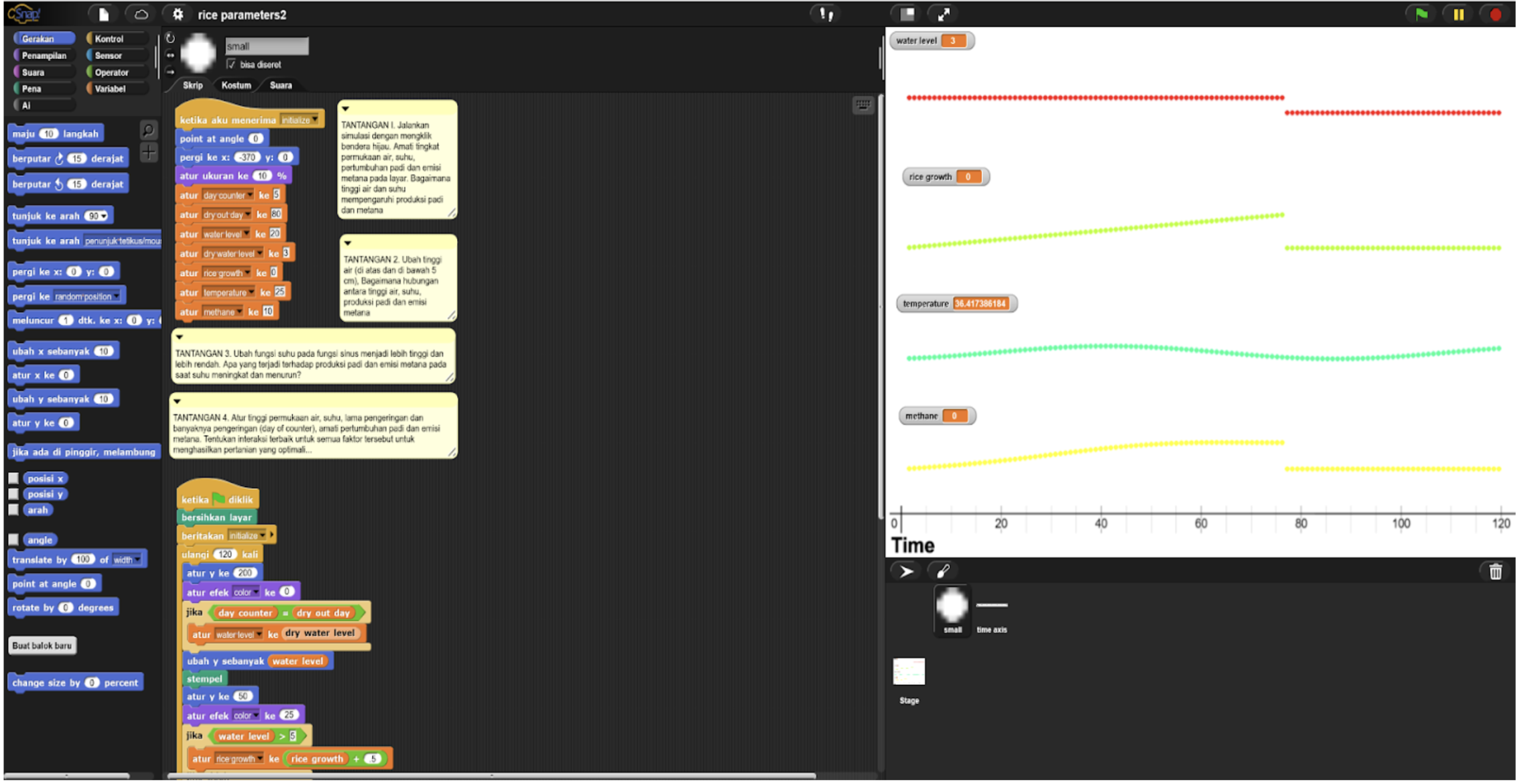
Figure 4. Screenshot of the CSDT simulation
- Producing a product. Each expert group prepares a product from its findings: graphs, tables, infographics, or a short scientific report.
- CSDT simulation (Subak system balance). During the simulation, each expert group addresses the following challenges:
- CHALLENGE 1. Goal: Analyze how changes in water level, temperature, and rice growth affect methane emissions. Instructions: Run the simulation by clicking the green flag. Observe water level, temperature, rice growth, and methane on the screen. How do water height and temperature affect rice production and methane?
- CHALLENGE 2. Goal: Test how changing water level affects rice growth and methane emissions. Instructions: Change water height (above and below 5 cm). What is the relationship among water height, temperature, rice production, and methane?
- CHALLENGE 3. Goal: Analyze how temperature swings affect rice growth and methane emissions. Instructions: Change the temperature function from the sine function to higher and lower values. What happens to rice production and methane when temperature rises and falls?
- CHALLENGE 4. Goal: Analyze how changes in water level, temperature, and methane emissions interact in rice growth. Instructions: Adjust water level, temperature, drying duration, and number of drying cycles (day counter); observe rice growth and methane. Find the best combination of factors for optimal farming.
4. Expert group assignments
- Expert group 1 (Temperature and methane analysis). Topic: Effects of soil temperature and water management on methane emissions in the paddy. Tasks: (1) Analyze how soil temperature and water volume affect methane emissions; (2) Use the CSDT simulation to measure and analyze effects of temperature and water management on methane; (3) Present the analysis in a graph showing relationships among soil temperature, water management, and methane. Product: A graph of soil temperature, water management, and methane emissions.
- Expert group 2 (Temperature and water volume data). Topic: Processing experimental data on temperature and water volume and analyzing links to rice yield. Tasks: (1) Process experimental data on soil temperature and water volume from the CSDT simulation; (2) Analyze relationships among water management, soil temperature, and rice yield and draw relevant conclusions; (3) Create graphs or tables showing relationships among soil temperature, water volume, and rice yield. Product: A table linking soil temperature, water volume, and rice yield.
- Expert group 3 (Biodiversity and ecosystem). Topic: Effects of water management on the ecosystem and biodiversity. Tasks: (1) Analyze effects of water management on the ecosystem, especially under intermittent irrigation (macak-macak); (2) Prepare an infographic on effects of water management on biodiversity and soil quality around the paddy. Product: A flow diagram of social and ecological effects of water management on the ecosystem.
- Expert group 4 (Subak balance simulation report). Topic: A short report linking paddy water management, water temperature, rice production, and methane emissions. Tasks: (1) Write a short report with title, introduction, objectives, methods (simulation process), simulation results, conclusion, and recommendations; (2) Create a concept map of the report. Product: A concept-map report including at minimum title, objectives, methods, results, conclusions, and recommendations.
- Expert group 5 (CSDT simulation technology). Topic: Using technology in CSDT-based experiments to monitor soil temperature, water volume, and methane. Tasks: (1) Use the CSDT simulation to monitor soil temperature, water volume, and methane in near real time; (2) Analyze how technology can support water management and data-driven solutions. Product: A demonstration of the CSDT simulation explaining how technology helps monitor and analyze experimental data.
5. Return to home groups (20 minutes)
After expert-group discussion, students return to their home groups.
- Each expert group shares its work with the home group; other students ask questions or respond to the topics presented.
- Each home group records at least 10 main points (keywords of at most three words each) summarizing the home-group discussion—for example, biodiversity, methane emissions, and so on—with each keyword on a separate sticky note.
- Each home group arranges the keywords on an O-map on the provided paper and connects them with arrows to show cause-and-effect relationships.
6. Closing (20 minutes)
- The teacher asks one group to present its O-map cause-and-effect links, then gives feedback on the home-group maps.
- The teacher asks students to draw on sticky notes (for example, a face looking down, a dizzy head, or a smiling face) with a short sentence that best reflects how they felt during the lesson. Use different sticky notes: (1) Green: satisfied, happy, interested; (2) Red: disappointed, bored, angry; (3) Yellow: confused, unsure, neutral.
- The teacher asks several students to sort the notes by color and count each color. If many students feel confused or disappointed, the teacher can offer simpler explanations or clarify difficult concepts.
- The teacher asks for suggestions on what could make the next lesson more enjoyable and easier to follow, and whether there are better ways to explain the material.
- The teacher previews the next lesson and closes with a farewell.
H. STAGE I PBL ASSESSMENT
1. Individual student assessment in expert groups (facilitator review; peer review; self-review)
| Criterion | Brief description | Score 1 (Inadequate) | Score 2 (Adequate) | Score 3 (Good) | Score 4 (Very good) |
|---|---|---|---|---|---|
| Understanding of content | How well students understand and explain the topic studied during discussion. | Does not meet criteria overall | Meets 1 of 3 criteria | Meets 2 of 3 criteria | Explains concepts accurately, thoroughly, and with clear links among ideas |
| Participation in discussion | Level of active participation in group discussion, including contributing ideas and listening to others. | Does not meet criteria overall | Meets 1 of 3 criteria | Meets 2 of 3 criteria | Offers opinions, responds to others, and gives constructive feedback in discussion |
| Communication skills | Ability to express ideas clearly and use appropriate language during presentation or discussion. | Does not meet criteria overall | Meets 1 of 3 criteria | Meets 2 of 3 criteria | Presents ideas in a clear, logical, systematic way |
| Collaboration skills | How well students work in groups, listen to peers, and respect others’ views during discussion. | Does not meet criteria overall | Meets 1 of 3 criteria | Meets 2 of 3 criteria | Contributes fully, flexibly, and responsibly in the group |
| Use of resources | Ability to use resources or references (e.g., experimental data or other sources) to support discussion and presentation. | Does not meet criteria overall | Meets 1 of 3 criteria | Meets 2 of 3 criteria | Uses resources validly and relevantly and integrates data with references effectively |
2. Individual expert assessment in home groups (facilitator review; peer review; self-review)
| Criterion | Brief description | Score 1 | Score 2 | Score 3 | Score 4 |
|---|---|---|---|---|---|
| Understanding of content | How well students explain concepts from the expert-group topic. | Does not meet criteria overall | Meets 1 of 3 criteria | Meets 2 of 3 criteria | Explains clearly, accurately, and completely |
| Clarity of delivery | Ability to present information in a structured, easy-to-follow way. | Does not meet criteria overall | Meets 1 of 3 criteria | Meets 2 of 3 criteria | Presents explanations clearly, completely, and systematically |
| Communication ability | How well students communicate, speak audibly, and sound confident. | Meets 1 or does not meet criteria overall | Meets 2 of 4 criteria | Meets 3 of 4 criteria | Communicates in a clear, engaging, systematic, confident way |
| Audience engagement | Ability to involve the audience in the presentation and answer questions. | Does not meet criteria overall | Meets 1 of 3 criteria | Meets 2 of 3 criteria | Engages the audience actively, relevantly, and meaningfully |
| Use of media/visuals | Ability to use visuals (images, diagrams, slides) to clarify the presentation. | Does not meet criteria overall | Meets 1 of 3 criteria | Meets 2 of 3 criteria | Uses appropriate, engaging, effective media |
3. Expert group product assessment (facilitator review; peer review; self-review)
| Criterion | Description | Score 1 (Inadequate) | Score 2 (Adequate) | Score 3 (Good) | Score 4 (Very good) |
|---|---|---|---|---|---|
| Conceptual understanding | How deeply the group demonstrates understanding of the topic. | Does not meet criteria overall | Meets 1 of 3 criteria | Meets 2 of 3 criteria | Product reflects clear, accurate, complete understanding |
| Links among concepts | Clear links among water management, temperature, methane, and yield in the final product. | Does not meet criteria overall | Meets 1 of 3 criteria | Meets 2 of 3 criteria | Conceptual links are clear, logical, and systematic |
| Creativity and innovation | How creative and innovative the final product is in presenting ideas and solutions. | Does not meet criteria overall | Meets 1 of 3 criteria | Meets 2 of 3 criteria | Product is distinctive, engaging, and aligned with the solutions |
| Structure and organization | How well the product is structured and easy for the audience to follow. | Does not meet criteria overall | Meets 1 of 3 criteria | Meets 2 of 3 criteria | Product is clear, complete, and systematic |
| Use of data and facts | Use of experimental data or relevant facts supporting the findings in the product. | Does not meet criteria overall | Meets 1 of 3 criteria | Meets 2 of 3 criteria | Data are accurate, complete, and support the findings |
| Participation of all members | How much each member contributed to the final product. | Does not meet criteria overall | Meets 1 of 3 criteria | Meets 2 of 3 criteria | Product reflects all members’ contributions, clear roles, and shared responsibility |
| Conclusions and recommendations | Ability to draw evidence-based conclusions and offer relevant recommendations. | Meets 1 or does not meet criteria overall | Meets 2 of 4 criteria | Meets 3 of 4 criteria | Conclusions are clear, complete, aligned with the problem, and matched with recommendations |